
Some applicants arrive with a perfect profile and a story that almost writes itself. My friend David wasn’t that applicant…at least not the first time around.
One year before he was admitted to Stanford’s MS in Management Science and Engineering program, David was, in his words, “heartbroken by rejection.”
He’d applied. He’d worked hard. He had a great tech career in the Bay Area. He had a previous master’s from a top-5 program. And he thought he’d written pretty solid SOPs. But Stanford is a tricky monster, isn’t it? It takes a lot more than good credentials to earn your place on that fancy, red-roofed campus with all its shimmering oak and palm trees.
Over the following eight months, David didn’t wallow in self pity. Instead, he rebuilt his application from scratch. He took two quant-heavy courses to offset weak GRE scores. He updated his resume to reflect significant changes at work. And he dug deep into his own story until he found the real narrative buried underneath—a story about a problem that troubled him at work. It was a problem that affected real people in his life, and one he knew he could help solve.
Then…he rewrote his statement of purpose 30 times.
That’s right. Thirty times.
The result was one of the most strategic and compelling SOPs I’ve ever encountered. And this past cycle, Stanford said yes. In fact, as I told David over email:
“I don’t think Stanford even had a choice in the matter…with writing this lucid, you were un-rejectable!”
What follows is that “un-rejectable” essay, along with an analysis of David’s writing process and some actionable tips that will (hopefully) help you write an SOP that’s similarly spectacular.
How He Found His Story
In our celebratory emails after David was admitted, he described his writing process according to three principles. Frankly, I think they’re genius. Not because David’s principles map almost exactly onto the WriteIvy methodology, but because they reveal the kind of intense introspection that’s required of a Stanford student. Or a Georgia Tech student. Or an MIT student. Let’s read these principles in David’s own words.
Principle #1: The answer lies within the prompt.
“I treated the prompt like a checklist. I’d read it word by word, then read my essay and ask: Did I actually answer what they asked, in the order they asked it? I tried to be the receiver—stepping back and judging whether every question the prompt raised was clearly addressed. It sounds simple, but I was surprised how many early drafts wandered away from what was actually being asked.”
Follow the prompt—excellent. This might sound obvious to you, but honestly it’s astonishing how often applicants read the prompt once, then write the thoughtless “autobiography” essay they wanted to write anyway.
Personally, I don’t think it’s necessary to follow the exact written order of the questions and suggested topics as they appear in the prompt. But clearly this kind of methodical thinking worked for David (and probably explains why he’s such an incredible product manager).
Principle #2: You must carefully design your story
“Before writing a single sentence, I storyboarded the narrative. What’s the arc? Where does it rise, where does it dip, and how does it connect back to the prompt? I’d review the storyboard with different people, iterate on the flow, and only then let paragraphs take shape — then sentences, then words. The macro structure had to work before the micro details mattered. I went through three completely different storylines before landing on the one that felt right.”
Beautiful. If you aren’t already aware that great SOPs are stories, then stop whatever you’re doing right now and heed David’s advice. Trust me. It’ll pay huge dividends when admissions get announced.
Principle #3: Iterate until you can honestly say it is the best work you are capable of producing
“I did about 30 iterations once the story was decided. I rotated feedback across different groups to avoid exhausting any single reviewer. I knew I was done when I stopped getting actionable feedback, and when I could read the entire essay without wanting to change a single word. There was a stretch of a few weeks where I’d open it, read it, and close it unchanged. That’s when I knew.”
Thirty drafts.
Thirty drafts!
If you think this kind of meticulousness is overkill, then you may not understand what schools like Stanford look for in their engineers. In fact, this is exactly what the Master’s SOP Formula demands you do: get exhaustive feedback from everyone in your academic circle with a qualified opinion.
Unfortunately, most students resist that demand. Yes, it’s slow. Yes, it’s awkward and painful. Yes, it requires you strangle that voice in your head that’s overly proud of itself (and that sounds an awful lot like AI). The voice that says hey this is pretty good. The voice that doesn’t actually want constructive criticism as much as a pat on the back.
Strangle that voice.
Be like David. Take the time. Iterate until you know you can’t possibly do any better. The quality of your essay (and admissions results) will show it.
Now, let’s take a look at David’s essay and see how he put these principles into action.
The Stanford MS&E Statement of Purpose
Cybersecurity often feels like riding a stock market chart—soaring highs on days when you stop an attack, and steep dips when you don’t. My steepest dip came in December 2024, when my best friend, Roberto, after being extorted through a compromised Telegram account, suffered an irrevocable tragedy that reverberated throughout our community. In the weeks that followed, as I grappled with grief and anger at my friend’s misfortune, I realized that cybersecurity must evolve from a reactive approach to proactive protection of society. Determined to channel this painful realization into preventing future tragedies, I joined the founding team of Sentinel at Wayne Digital to help design and scale proactive defenses for over 300 million potential users. This was my first step in transforming my personal conviction into a professional reality, translating my empathy for victims into a commitment to building a more secure digital world.
Yet, turning this commitment into reality proved challenging. Over the past year, as I helped build this Waynecorp venture from the ground up to over 40 million users, I encountered a series of interconnected obstacles that exposed critical knowledge gaps. It started with incorrectly sequencing market segments for growth, triggering months of expensive rework when we could least afford it. This strategic misstep then cascaded into failed attempts to develop proper decision criteria for a threat-detection platform, paralyzing progress for months while competition gained ground. The crisis reached its peak with a $16 million Collabspace scam that made headlines. Attackers used spoofed executive credentials and forged authorization to impersonate a company’s CFO, convincing the organization’s employees to transfer funds—exposing the exact threat mechanism I had failed to prioritize protecting against. Competitors seized on the incident as proof our product was vulnerable, decimating our monthly retention rate from 78% to 42% and forcing a costly pivot. Reflecting on this progression, several core questions emerged: Was the root cause misreading the market dynamics, competitive landscape, or customer impact? Was it inadequate decision-making training, flawed prioritization frameworks, or my inability to deconstruct sophisticated attacks into manageable defensive components? Or was it simply a matter of inexperience in translating research into production?
In the sleepless nights that followed, as I replayed these questions endlessly, I recognized these experiences as profound learning opportunities. What became clear was that my Master’s from Gotham University taught me the technical foundation to build and manage products, but I still needed more substantial strategic knowledge to build a company. After extensive research, I found that traditional educational paths focus primarily on either technical skills or business fundamentals, failing to integrate technical applications, entrepreneurial strategy, and decision theory under uncertainty to the depth required to bridge that gap. Stanford’s Master’s in Management Science and Engineering stands apart as the only program that truly integrates the interdisciplinary aspects of strategy, decision-making, and technology essential for entrepreneurship with real-world applications. Supported by a community focused on addressing societal challenges through entrepreneurship, the program provides the holistic, interdisciplinary expertise I need to build a proactive cybersecurity company to prevent tragedies like Roberto’s.
While my professional credentials and academic milestones provide a foundation, it’s my firsthand experiences navigating ambiguity and learning from failure that have truly prepared me for this rigorous, interdisciplinary MS&E journey. These experiences provide concrete case studies as I focus on three critical questions: How do I build sustainable competitive advantages in fastmoving markets? How do I make high-conviction decisions when data is sparse and mistakes are existential? How can emerging technologies, such as quantum computing and AI agents, be leveraged to safeguard society proactively?
To answer these questions, I’m planning to pursue the Technology and Engineering Management track within the Stanford MS&E program. Through MS&E 270: Strategy in Technology and MS&E 296: Technology and Power Competition, I will learn how to build a sound strategy so I don’t misjudge markets the way I did while scaling a security company. Building on this, MS&E 252: Decision Analysis will help me make principled choices in data-scarce environments and objectively evaluate retrospective decisions—addressing my struggle to develop proper decision criteria under pressure. On the technical side, I’ll use CS 356: Network Security and CS 521: AI Safety to learn how to quickly translate cutting-edge research into deployable protections, so I can anticipate threats like the spoofing attack rather than reacting after the damage is done. Finally, MS&E 273: Venture Accelerator and MS&E 297: Hacking for Defense will let me practice navigating the early-stage chaos I struggled with at Wayne Digital, this time with structure and mentorship rather than learning through costly mistakes.
Complementing this coursework, I plan to collaborate with the Probabilistic Communities Lab (PCL) to explore how network algorithms and social psychology can economically disincentivize digital attacks. To put this into practice, I hope to collaborate with Professor Lucius Fox, whose strategic expertise in cybersecurity will inform how my startup can leverage private ecosystems and engage with national security stakeholders. Additionally, I want to work with Professor Daggett on build-buy-partner decisions to develop the structured frameworks that will eliminate the decision paralysis that once stalled my progress for months.
Beyond academics, Stanford’s entrepreneurial ecosystem will help me transform these insights into societal impact. The Stanford Gordian Knot Center will connect me with national security experts who understand the systemic factors that make security an afterthought in the industry and how to address them. I’ll also work alongside founders in the Stanford Founders Community who are building companies that tackle hard societal problems, learning from those who’ve successfully navigated the challenges I’m facing. Finally, at Stanford Applied Cyber, I will master the hands-on skills to deconstruct sophisticated attacks into manageable pieces, turning my earlier inability to deconstruct complex threats into a core competency.
Armed with these capabilities, I plan to join an early-stage cybersecurity startup upon graduation, applying my knowledge to safeguard society from threats like autonomous AI systems and synthetic content. Through this startup experience, within three years, I aspire to found a company that builds proactive defenses against digital predators—protection that could have saved Roberto and will safeguard countless other families.

What Makes This SOP Work
To help YOU understand why this statement of purpose is so spectacular, I think it’s best to look at few things that might seem a bit…unconventional…at first.
He has no credentials paragraph (and doesn’t need one)
Most applicants spend half of their essay talking about their academic pedigree. Good grades they made. Classes they took. Research they assisted. Their entire scholastic biography.
David ignored all that.
Once, in passing, he mentions his previous master’s degree from a top-flight university (note: edited in this version as “Gotham University”). But he did so only to name the gap it left.
There’s no accounting of GPA, no list of technical skills, no paragraph dedicated to proving he belongs at Stanford. Nor is any of that necessary for David, because by the time you finish the second paragraph—by the time you understand the personal and professional disaster that made him care so much about his role in cybersecurity—the question of whether he’s technically qualified hasn’t even occurred to you.
He’s already thinking like a Stanford scholar. It’s right there on the page.
“Was the root cause misreading the market dynamics, competitive landscape, or customer impact? Was it inadequate decision-making training, flawed prioritization frameworks, or my inability to deconstruct sophisticated attacks into manageable defensive components?”
David was already doing the work they study in those hallowed halls at Stanford. He just wants to do it better, at a higher level, and that’s precisely why he now needs more education. The focus is entirely on what David wants to achieve in the future.
He makes an incredibly bold claim
Only Stanford. There’s literally no other school for David. He says this explicitly:
“Stanford’s Master’s in Management Science and Engineering stands apart as the only program that truly integrates the interdisciplinary aspects of strategy, decision-making, and technology essential for entrepreneurship with real-world applications.”
To most readers, that statement will sound like a glittering generality—the kind of fluffy, obsequious language that fills most rejected SOPs. In fact, in the Master’s SOP Formula, there’s an entire lesson telling you to avoid language like this! What’s more, it makes the reader want to say…what about MIT’s System Design and Management program? What about Columbia’s MS&E program? Are they not pretty good too?
No. Not for David.
First, he provides more context about why the Stanford MS&E program is uniquely relevant to his career and life experiences:
“Supported by a community focused on addressing societal challenges through entrepreneurship, the program provides the holistic, interdisciplinary expertise I need to build a proactive cybersecurity company to prevent tragedies like Roberto’s.”
Then, as if David knows that you’re about to call his bluff, he takes the time to patiently explain exactly how Stanford will prepare him to achieve his niche career goals. In fact, he provides four whole paragraphs constructing this irrefutable argument.
Which brings us to…
He talks more about his failures than successes
The latter half of David’s essay—the “Why This School” section—explains his exact, step-by-step plan for getting the most out of the MS&E program. The specialization he’ll choose. The classes he’ll take. The research he’ll pursue. He declares it all. It’s a foolproof plan.
What’s truly fantastic, however, is how each step of this study plan “corrects” one of the failures or knowledge gaps that he mentioned in his introduction—those that altered his career forever. As he said:
“…it’s my firsthand experiences navigating ambiguity and learning from failure that have truly prepared me for this rigorous, interdisciplinary MS&E journey.”
When he says he plans to take courses on tech strategy, he does so for one reason…
“…so I don’t misjudge markets the way I did while scaling [at Wayne Digital].”
When he says he wants to help faculty conduct research on build-buy-partner decisions, he knows this will allow him to…
“…develop the structured frameworks that will eliminate the decision paralysis that once stalled my progress for months.”
This self-aware, problem-solving mindset is relentless throughout the whole second half of the SOP. David isn’t telling us how great, how smart, how impressive he is. He’s telling us what went wrong in his past, and how Stanford can help him correct it—both for himself, and for the startup teams he plans to lead in the future.
How Do You Write About Personal Tragedy in a Statement of Purpose?
David’s SOP opens with a painful story. His friend fell prey to a phishing scam that caused immense turmoil for his family. It’s the (subtle) emotional engine of the essay, because these are the exact types of problems David works to help people avoid in his career.
Not everyone has a story like this. Nor does a good SOP require one. And honestly…it’s really difficult to pull off.
When written poorly, a story like this becomes trauma dumping—an implicit request for sympathy that doesn’t connect to any intellectual reason for you to be admitted. It says: “I’ve had a hard time, please help me out!”
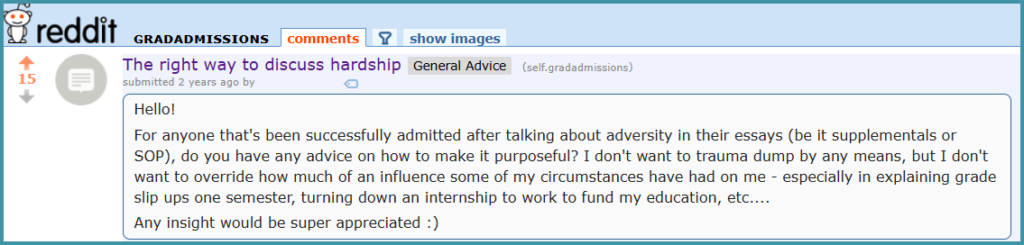
Unfortunately, many applicants think they need a story like this to get admitted. Reddit overflows with students asking for advice on their “hardship hook.”
David, however, wasn’t asking for sympathy at all.
He told his friend’s story for one reason: to explain why cybersecurity has become a personal mission for him (rather than just a professional interest) and why he now feels so troubled by reactive security work.
It introduces the problem he wants to learn to solve.
In the Master’s SOP Formula, we call this your “Frame Narrative Introduction.” It’s not the entire story, but the envelope that contains your bulletproof, intellectual argument for admission.
In David’s case, this story establishes why he cares so much about safeguarding society’s digital lives, and why his relationship to the problem changed in the middle of his career. From that point on, he’s free to pivot toward the strategic thinking that permeates the rest of the essay. The story of tragedy appears once, then disappears, replaced by an account of…
The startup challenges that exposed his knowledge gaps…
A precise articulation of how the MS&E program can fill those knowledge gaps…
A Study Plan that maps directly onto those knowledge gaps…
And ultimately, an incredibly strong argument that—with a Stanford education—he’ll be able to help people like his friend avoid tragedies in the future.
That’s the magic trick. In a great SOP, personal tragedies aren’t requests for sympathy. Nor are they explanations for weaknesses in your profile. They’re just the ignition button. They’re the moment when you discovered a problem that you’re now intensely eager to solve.
What Is the Stanford MS&E Program Looking For?
Stanford’s Management Science and Engineering program is, frankly, unusual. It’s not tech. It’s not business. It’s a definitively interdisciplinary program that mingles engineering, strategy, and decision science, and it’s explicitly designed for people who want to build things.
Companies? Of course.
Policy initiatives? Absolutely.
Research agendas? You’re 100% welcome too.
This make things tricky for applicants. The SOP can’t just demonstrate technical genius, the way a CS or Biomedicine application might. It also can’t glow with business ambition, the way an MBA essay might. As I often tell students: Stanford doesn’t want people with billion-dollar business ambitions. They want technical geniuses who care deeply about solving real human problems.
It just so happens that real human problems are often worth billions of dollars when they’re solved.
An MS&E applicant needs to show both: an eagerness to solve big problems, and the organizational savvy that makes us believe they might actually build something meaningful one day. David’s essay strikes this balance as beautifully as any SOP I’ve ever seen.
Can You Reapply to a Top Master’s Program After Rejection?
Yes—David’s case is proof that a reapplication can succeed, even at a program as selective as Stanford MS&E. But the keyword in his story is rebuilt…not revised.
Applicants who get rejected on a second attempt have usually only made incremental improvements to their profile. A slightly better resume. A new recommendation letter. Some personal statement tweaks. And of course, David did all this.
The second time, however, David became an entirely new applicant. His SOP told a fundamentally different story, one that, honestly, didn’t exist until he’d lived through it.
The first year, he was a solid candidate. Fantastic credentials. Obviously very smart and successful. But the second year, he was a man on a mission. His story was no longer about a product manager seeking to boost his career. It was about a problem that desperately needs to be solved, and why David is the right man to tackle it.
In this way, rejection (if you handle it correctly) could be the most useful data point in your application process. It’s a debugging tool. It tells you that something wasn’t working. The question is whether you’re willing to do the diagnosis honestly, and then, do the work to fix it.
David did both, and I’m guessing you can do this too. Whether you’re an engineer, a scientist, or a corporate exec, isn’t this what you do every day anyway? Look at failures, debug, and iterate until you succeed?
Conclusion on the MS&E SOP
David’s success didn’t arise from the fact that he’s a compelling person, an excellent product manager, a business leader—though obviously he’s all the above. It arises from the fact that he came to understand (eventually) that the SOP is an argument…not a biography.
Every word, every sentence of his essay serves to prove a single claim:
- I’ve encountered a real problem
- I’ve failed to solve it with the tools I have
- Stanford MS&E is the only place that will give me the tools I need to solve it in the future, and make a real difference in real people’s lives
That’s the essay. Everything else is secondary evidence.
If you’re writing your own MS&E SOP (or rebuilding one) start there. What’s the problem you’re trying to solve? What’s standing in your way? And why is this program the specific answer to that specific gap?
When you can answer those three questions in a single paragraph (or even a single sentence)…congrats. You’ve just rocketed to the top of the application pile.
Hopefully it won’t take you thirty revisions to get there.
—-
Want to avoid all these mistakes and pitfalls before you even start? The Master’s SOP Formula teaches you—step by step, sentence by sentence—how to write the kind of SOP argument that schools like Stanford actually want you to write.
